
TL;DR
Quentin Tarantino's *Kill Bill* owes a huge debt to the wild 1973 Japanese cult film *Sex and Fury*! This newly restored, uncut edition showcases Christina Lindberg in a raw, violent "Pinku Eiga" tale of revenge in 1880s Japan. Follow a brutalized woman's descent into a world of mafia assassins and deadly sword fights, eerily echoing *Kill Bill*'s most iconic scenes. Discover the unpolished intensity that inspired Tarantino's masterpiece. Ready to see where *Kill Bill* truly began? Dive into the full review to learn more!
Sex and Fury—the film whose fight scenes Quentin Tarantino drew heavily from for Kill Bill
Quentin Tarantino has always viewed Kill Bill as a single feature film. That it was released in cinemas divided into two separate films, Volume 1 (2003) and 2 (2004), was primarily because cinema owners were hesitant to allocate such extensive screen time to a single 4-hour and 35-minute feature.
However, this has now changed. In the USA, Kill Bill: The Whole Bloody Affair is being presented as Tarantino originally envisioned it—in a single sitting, featuring approximately seven minutes of previously unreleased animated sequences, and with a 15-minute intermission.
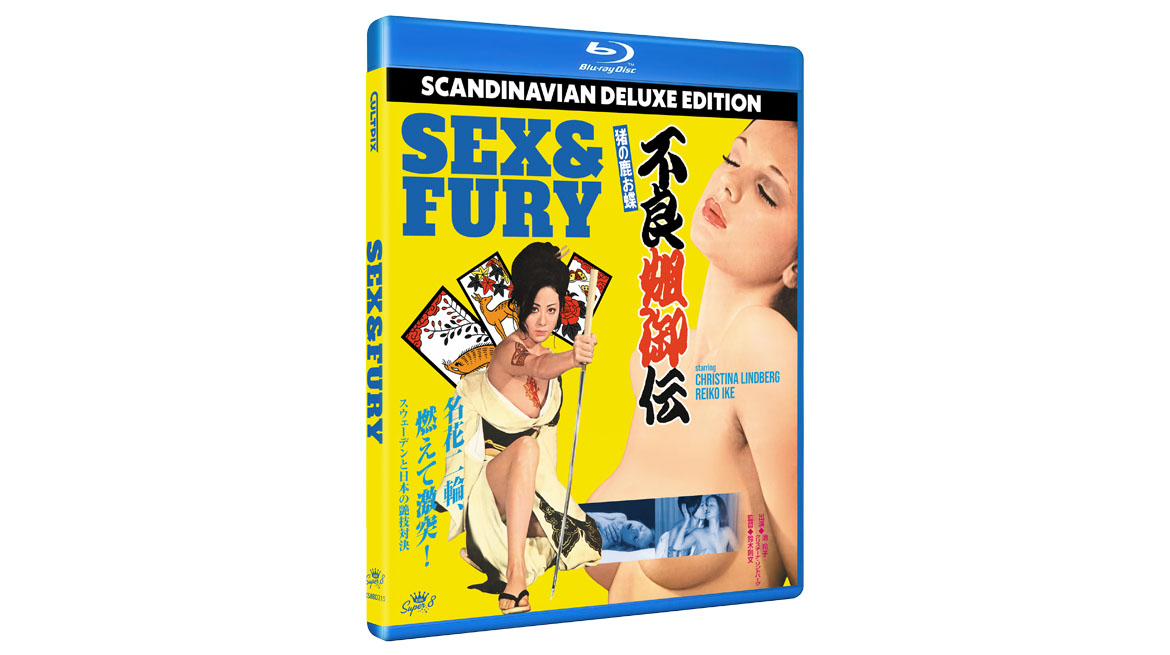
Currently, no Swedish distributor has yet announced plans to screen this version. However, a notable alternative is Klubb Super 8‘s recent release of a newly restored and completely uncut Scandinavian Deluxe edition of Sex and Fury (1973). Timed to coincide with the 75th birthday of the iconic Christina Lindberg, this Japanese cult classic features Lindberg in a leading role and is a known source from which Tarantino drew significant inspiration for Kill Bill. The release was celebrated with a special screening at Cinema Victoria in Stockholm, where Lindberg was present alongside friends and acquaintances, followed by dinner and cake.
Sex and Fury takes place in 1880s Japan.
The film is based on Tarō Bonten’s 1970s manga series. Its cinematic adaptation falls under the “Pinku Eiga” genre, or “Pink Violence,” a Japanese subgenre of exploitation cinema. This genre is characterized by violent narratives that often incorporate softcore pornography, elements of exploitation, and feature formidable female avengers, frequently depicted in nude combat. The genre experienced its peak from the late 1960s to the mid-1970s, during which the Japanese film industry, notably companies like Toho and Toei, prolifically produced these “Pinku Eiga” films.
The narrative of Sex and Fury bears a notable resemblance to that of Lady Snowblood, released in the same year. Both films portray a young girl who, shaped by her childhood trauma, transforms into an uncompromising avenger.
In Sex and Fury, a child witnesses the brutal street murder of her father, a policeman, by mafia assassins. She is subsequently adopted by a woman who earns her living as a pickpocket, and who raises her according to the harsh realities of the criminal underworld.
As an adult, Inoshika Ochō (Reiko Ike) operates as a card shark and pickpocket, concurrently journeying to Tokyo to avenge her father. Ochō is also affiliated with the Japanese mafia, exceptionally proficient in combat and marksmanship, and has been trained in deadly swordplay by female Yakuza.
Ochō’s sole clue consists of three playing cards, depicting a wild boar, a deer, and a butterfly, clutched by her dying father. Reflecting her life’s mission, she has adopted the name Inoshika, a combination of the Japanese words for wild boar (ino), deer (shika), and butterfly (Ochō).
Her investigation leads to three men, each bearing a tattoo of these animals on their back, which culminates in a brutal showdown within the criminal underworld.
Prior to this, Ochō’s plans are complicated when her path converges with Christina (played by Christina Lindberg, credited as Kurisuchina Rindobaagu). Christina is an alluring British agent, dispatched to Japan with her superior to instigate a new opium war between Japan and the British Empire.
The precise mechanisms or motivations behind this plot point remain unclear within the narrative.
The film was a great success in Japan.
The film rapidly spawned a sequel, Female Yakuza Tale: Inquisition and Torture, released a mere five months later, with Reiko Ike reprising her role. Christina Lindberg had already achieved considerable popularity in Japan through her appearances in several European films. However, her character’s demise in Sex and Fury naturally precluded her involvement in the sequel.
Christina has recounted her enjoyment of her time in Japan and found the filming experience there agreeable. She even delivers a few lines in Japanese in Sex and Fury. Her credits also include an appearance in Poruno no joô: Nippon sex ryokô (Porno Queen: Japan Sex Tour). However, when offered a five-year contract by the film company Toei, Christina declined.
—The roles offered had an excessive focus on sexual violence (‘rape’) with insufficient elements of retribution (‘revenge’), she noted.
—Furthermore, an offer for a role in the film Anita – ur en tonårsdagbok alongside Stellan Skarsgård in her native Sweden presented a more appealing prospect.
It is evident why Tarantino was fascinated by Sex and Fury and “borrowed” elements for Kill Bill.
Consider the thrilling staircase fight. The influence becomes even more apparent in the bloody sword fight amidst the snow: a nude Reiko Ike confronting a horde of armed Yakuza thugs, with dismembered limbs graphically depicted. The imagery is both graceful and brutally beautiful against the freshly fallen snow. Technically, Tarantino’s rendition may exhibit greater polish.
However, the raw intensity and electric atmosphere inherent in Norifumi Suzuki’s groundbreaking masterpiece are unparalleled and defy replication. It is curious that Tarantino did not incorporate the bizarre sequence where a group of nuns abruptly produce stiletto knives and engage in combat.
Furthermore, he also drew inspiration for Darryl Hannah’s aesthetic in Kill Bill from Christina Lindberg’s portrayal in Thriller – en grym film. The climactic scene in Sex and Fury was directly repurposed by Tarantino for the showdown between Uma Thurman and Lucy Liu in Kill Bill Volume 1, replicating its editing and musical cues. Whether categorized as homage or theft, the result is undeniably brilliant in either interpretation. Nevertheless, the original film retains its distinct and enduring artistic merit.
In this film, the vibrant cinematography elevates even a scene depicting Christina Lindberg and Reiko Ike playing poker to an unexpectedly sophisticated level.
The fight sequences diverge from those typically found in most other Asian “action films”; here, intricate choreography is eschewed in favor of more primitive, street-brawl-like confrontations where characters push, stumble, and impede one another. Admittedly, the clumsy dialogue and humor involving flatulence and condoms appear both dated and distinctly Japanese, representing elements that may not fully resonate with a Western audience. Yet, these aspects contribute to its distinctive character.
As with many Japanese and Hong Kong-produced films of the era, torture scenes and references to anti-colonialism are prevalent in Sex and Fury. Such elements were commonly employed well into the 1990s. Ochō’s quest for vengeance is further interwoven with a subplot where she has vowed to liberate a man’s sister from the brothel into which she was sold.
Furthermore, Christina harbors a long-standing desire to reunite with a Japanese lover. He is revealed to be the same revolutionary (Tadashi Naruse) who ineptly attempted the assassination of the Yakuza’s new boss and whom Ochō is now protecting from the mafia’s dispatched enforcers.
Similar to Italian giallos, one must contend with certain narrative inconsistencies. Maintaining a clear understanding of the numerous subplots and characters can occasionally prove confusing and chaotic. It appears Christina’s character was primarily introduced to appeal to the Japanese audience with the inclusion of an attractive, nude Western female, yet logical coherence is rarely the primary appeal for audiences drawn to such genre films.
Indeed, the film’s compelling blend of explicit nudity, gratuitous sex scenes, intense martial arts, and graphic sword fights has resonated widely. This is an exhilarating Japanese production and stands as a seminal masterpiece within the “Pinku Eiga” genre.
The Blu-ray edition includes a range of compelling bonus materials, notably including the original trailer, archival photos, and Maid in Japan, an interview with Christina Lindberg regarding her experiences in Japan. The visual fidelity is commendable, featuring sharp colors; however, the original mono track exhibits a somewhat tinny audio quality.
Klubb Super 8 provided review copies for this evaluation. Material providers have no editorial influence on our assessments; our reviews are conducted independently, prioritizing the interests of our readers and consumers.
