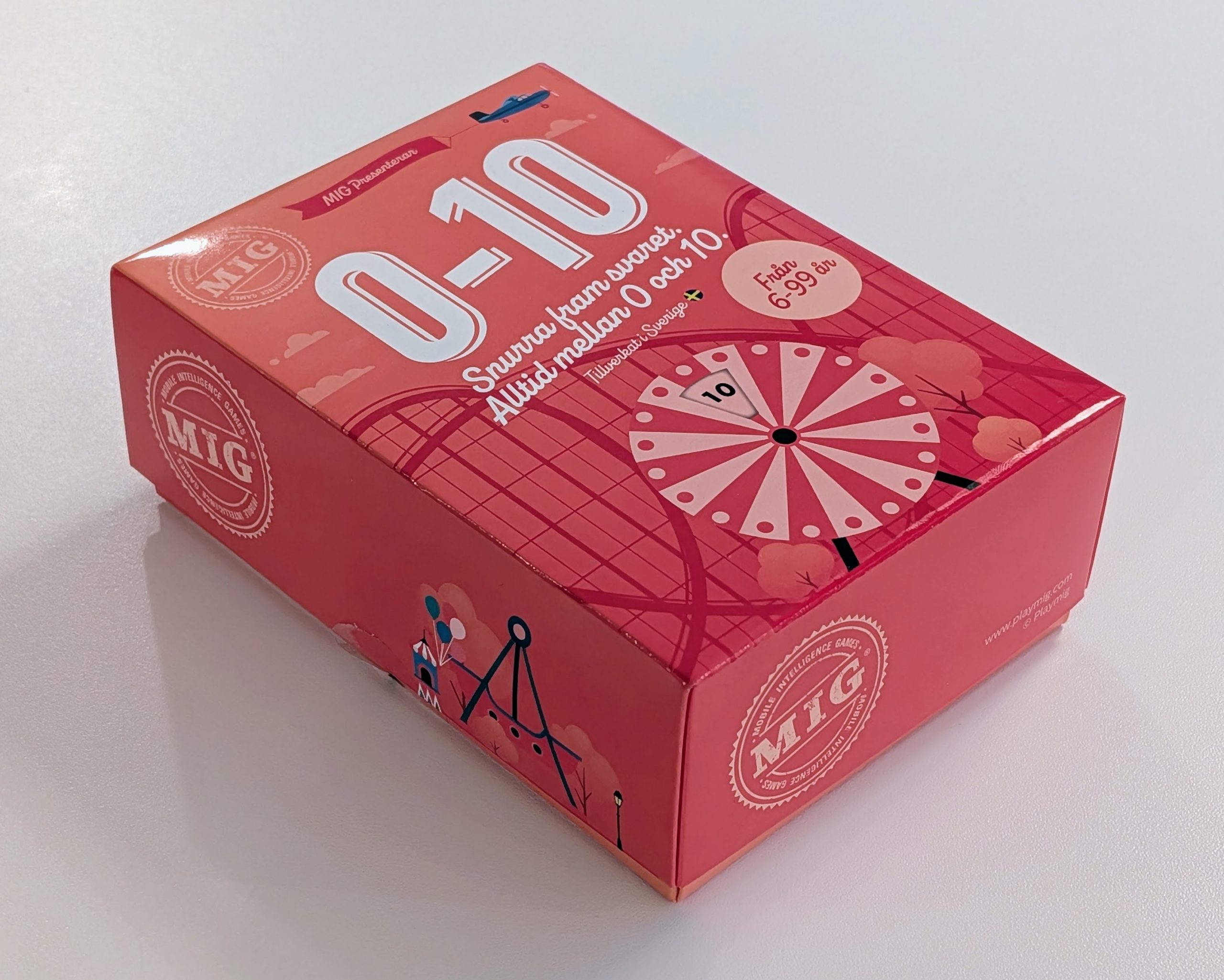

TL;DR
MIG 0-10 is a family-friendly quiz game where all answers are numbers between 0 and 10, making it accessible for all ages. While the game's core mechanics and handicap system brilliantly ensure fair competition between kids and adults, the construction of the spinners and limited score sheets feel a bit cheap for the price. It’s a fast-paced, engaging way to keep the whole family entertained without adults having to hold back. Dive into our full review to see if the fun outweighs the material concerns!
MIG, or Mobile Intelligence Game, is a brand with widespread recognition in Sweden. It frequently serves as a staple in glove compartments or summer cottages, typically brought out for entertainment during rainy days.
Our team has previously reviewed numerous iterations of their classic quiz game. Now, the brand introduces a new variant: MIG 0-10. This iteration clearly targets families seeking an inclusive play experience, where participants of all ages, from 6 to 76, can compete on equal footing.
The core concept dictates that all answers are numerical, falling within the range of zero to ten. While seemingly straightforward, this design addresses a fundamental challenge in traditional quiz games: the binary nature of knowing an answer or not. MIG 0-10 mitigates this by allowing players to always make an educated guess. This review will explore its practical efficacy.
Design and Components
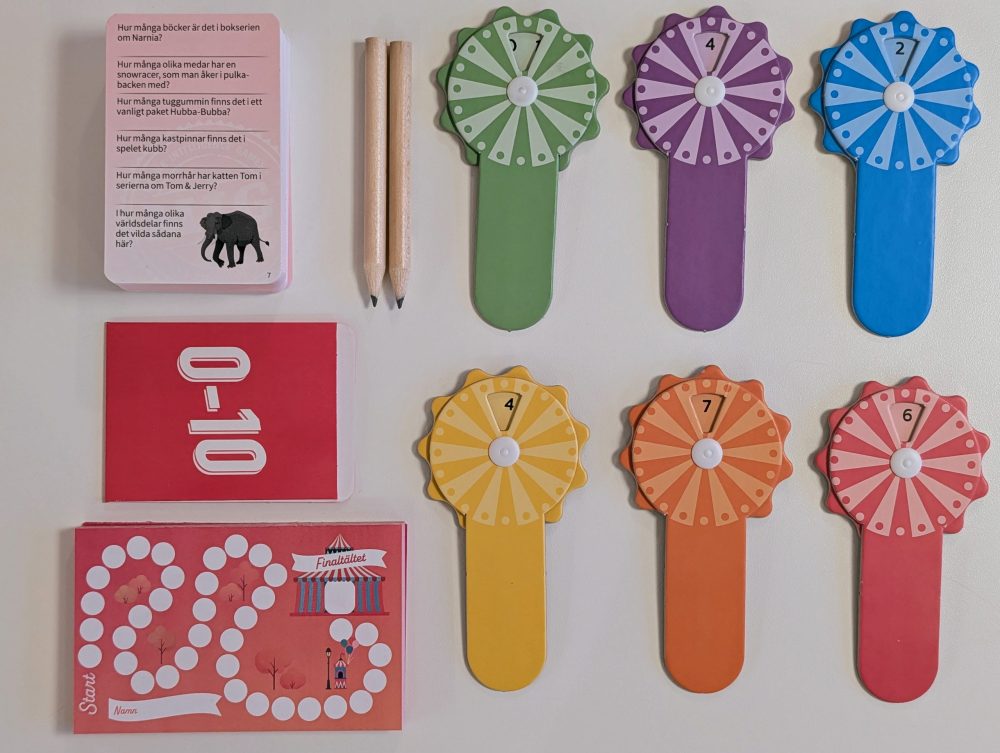
Upon opening the distinct reddish-pink box, the contents revealed include question cards, a score pad, two small pencils, and components for six color-coded number spinners.
At this juncture, a critical observation is warranted. Assembling the spinner components reveals their construction from cardboard. Players are required to self-assemble these with a small central plastic peg. For a game priced at nearly 350 SEK, this material choice appears cost-cutting. It fails to convey a premium aesthetic, and raises concerns regarding the durability of cardboard wheels after repeated use.
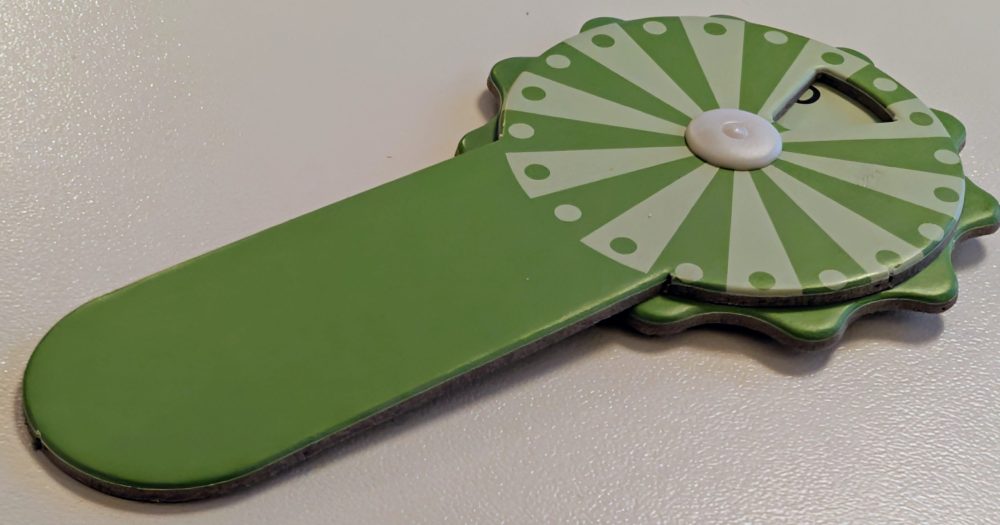
Once assembled, however, the spinners function effectively; a dedicated window clearly displays the selected number while concealing others, thereby mitigating the potential for inadvertent viewing or cheating. The inclusion of six spinners is a notable advantage, facilitating participation for larger groups.
Similarly, the game board deviates from a traditional rigid design, instead comprising loose paper sheets on which players track their progress toward the “Final Tent”. This approach offers benefits in terms of compactness and portability. Conversely, it contributes to a perception of the game as a consumable item rather than a durable board game component.
Furthermore, the package includes approximately 50 game sheets. While each sheet is double-sided, effectively providing two uses, a family of five is likely to deplete the supply rapidly. (Replacements can be purchased at cost price on playmig.com).
Game Rules and Setup
While the material choices leave something to be desired, the game mechanics are commendably robust. The setup exhibits an ingenious simplicity. One player reads a question, such as “How many different types of coins are there in Sweden?” All participants then secretly input their numerical answer on their respective spinners. At a predetermined signal, all answers are revealed simultaneously.
This design virtually eliminates downtime. Players are not subjected to periods of waiting while others contemplate their responses. Instead, continuous engagement is maintained, a factor critical for sustaining the interest of younger participants.
However, the most innovative and commendable feature of the game is its integrated handicap system. This system is structured into three age-based tiers:
- 12 years or older: are awarded 3 squares for a perfectly correct answer, and 1 square if they are one step away.
- 9–11 years: are awarded 4 squares for a perfectly correct answer, and 1 square if they are one step away.
- 6–8 years: are awarded a full 5 squares for a correct answer, and 2 squares if they are one step away.
This system effectively ensures that a seven-year-old possesses a genuine opportunity to surpass both their ten-year-old sibling and their parents, advancing significantly on the game board even when older players achieve higher accuracy. It fosters a level of competitive balance and excitement rarely observed in family-oriented games.
This advantage extends into the endgame, specifically the “Final Tent” phase. To achieve victory, an adult must provide a precisely correct answer to the final question. In contrast, children aged 6–8 can claim victory by being within a single numerical increment of the correct answer.
The Questions
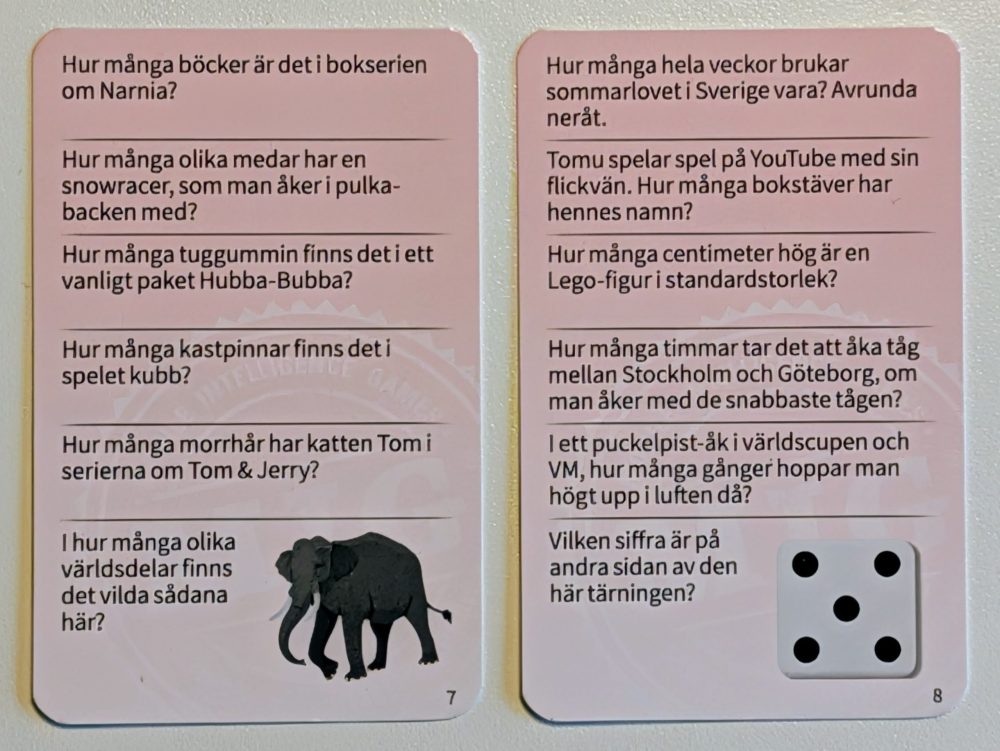
Our team has analyzed a significant portion of the 462 questions, and the thematic diversity is highly commendable. The compilation extends beyond traditional knowledge-based queries. It incorporates contemporary references, such as popular YouTuber Tomu and his partner Yumi (topics familiar to children but often unknown to adults), alongside questions spanning geography, history, and more lighthearted, imaginative scenarios.
Given that answer options are restricted to the 0-10 range, no question is truly insurmountable. In instances of uncertainty, players can employ a central guess of five or formulate an estimate based on their judgment, thereby always having an opportunity to score.
Conclusion
MIG 0-10 effectively succeeds in making quizzing enjoyable for the entire family, eliminating the need for adults to intentionally underperform to maintain engagement. Its swift gameplay ensures that a typical round concludes within approximately 15 minutes, making it an ideal choice for a casual Friday evening before a film.
We express disappointment regarding the choice of unassembled cardboard spinners and the limited quantity of game boards (which are depleted rather quickly), particularly when more durable components could have been incorporated, especially given the price point (recommended price: 339 SEK). However, abstracting from the material limitations and focusing on the core gameplay experience and the efficacy of the mechanics in leveling the playing field, the product demonstrates considerable merit.
PlayMIG has astutely identified and elegantly resolved the challenge of children becoming disengaged when consistently losing to adults in knowledge-based games, achieving this through its differentiated scoring rules. While not ideally suited for adult-centric social gatherings, for families with children, it represents a highly recommended entertainment option.
PlayMIG provided review copies for this test. Material providers have no editorial influence on our reviews; we always write independently with our readers and consumers in mind.
